You and partner have found a fit. You have the points for slam. But there's one problem: if the opponents can cash two aces right off the top, you're going down immediately. How do you find out?
Enter the Blackwood convention. One bid-4NT-asks a simple question: "Partner, how many aces do you have?" The answer determines whether you bid slam or stop safely in game.
Blackwood is one of the most widely used conventions in bridge. It's powerful, elegant, and-when used correctly-prevents embarrassing slam failures. But it's also one of the most misused conventions. Players bid 4NT in situations where it creates more problems than it solves.
This guide covers when to use Blackwood, how the responses work, and-just as important-when not to use it.
What is Blackwood?
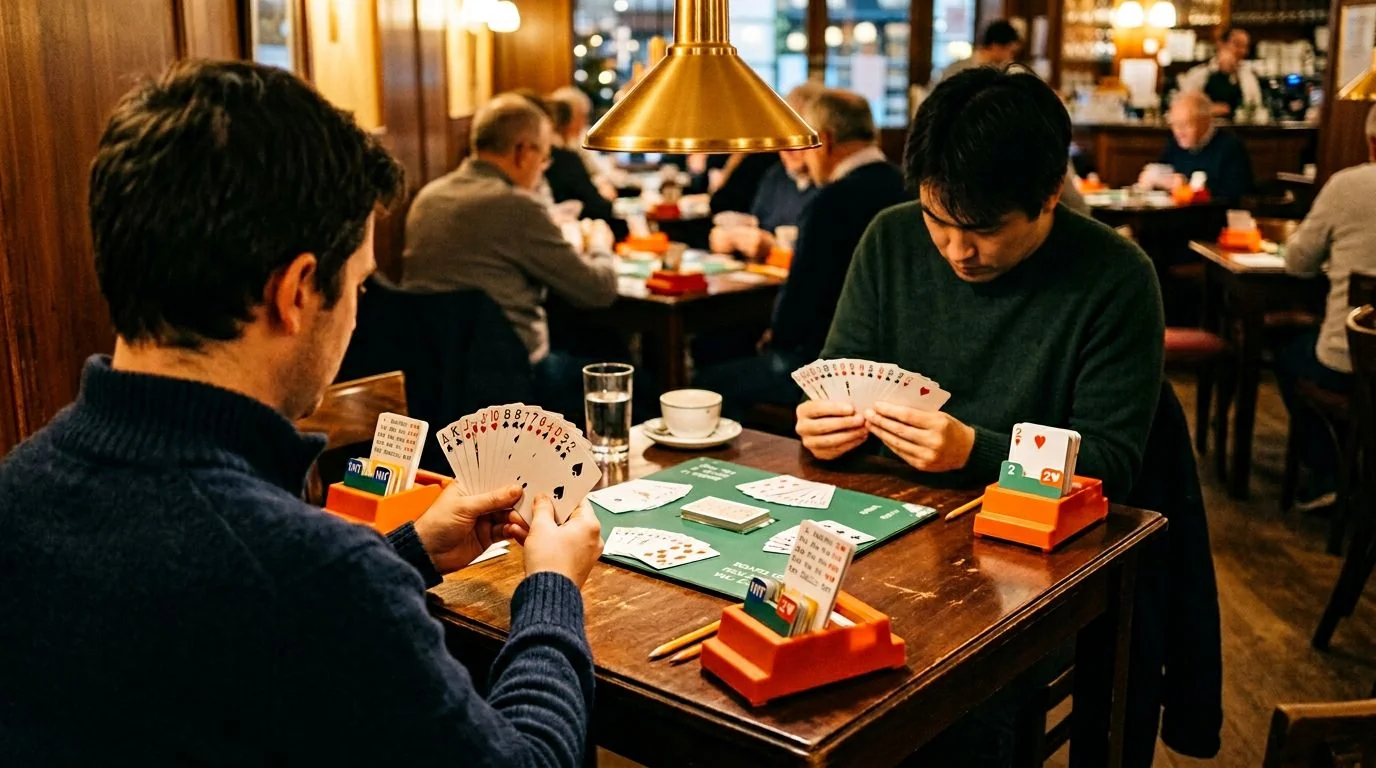
The Blackwood convention is an artificial bid where 4NT asks partner to show how many aces they hold.
It was invented by Easley Blackwood in 1933 and has been a staple of bridge ever since. The modern game features variations like Roman Key Card Blackwood (RKCB), but basic Blackwood remains the foundation.
The Blackwood Responses:
- 5♣ = 0 or 4 aces
- 5♦ = 1 ace
- 5♥ = 2 aces
- 5♠ = 3 aces
After the ace-showing response, the 4NT bidder decides whether to:
- Bid slam (6-level or 7-level) if you have all the aces you need
- Sign off at 5 of the agreed suit if an ace is missing
- Bid 5NT to ask for kings (showing all four aces are held by the partnership)
When to Use Blackwood
Blackwood is designed for one specific situation: you have the points and fit for slam, and you just need to check for aces.
The Three Requirements
1. Agreed trump suit (or planning to play in notrump)
You and partner must already know where you're playing. Blackwood asks "how many aces?" not "where should we play?" If you don't have a fit, don't use Blackwood.
2. Enough combined points for slam (usually 33+ HCP)
Small slams generally need 33+ HCP. Grand slams need 37+. If you're borderline on points, Blackwood won't help-you need to evaluate your hand more carefully first.
3. No void or singleton in an unbid suit that could be a problem
This is the killer. If you have a void or weak doubleton in a side suit, the opponents might have the ace-king there. Blackwood only tells you about aces, not about suit control. (See "When NOT to Use Blackwood" below.)
How Blackwood Works: Step-by-Step Examples
Example 1: Simple Blackwood in a Major Suit Fit
You hold (South):
♠ AKJ85 ♥ KQ3 ♦ A7 ♣ KJ4
(20 HCP: ♠8, ♥6, ♦4, ♣2 = 4+3+1+3+1+3+2 = 20 ✓)
Bidding:
South: 1♠
North: 3♠ (limit raise, 10-12 support points)
South: 4NT (Blackwood)
You have 20 HCP. Partner showed 10-12 with the limit raise. That's 30-32 combined-close to slam range. You have a solid spade fit. The question is: does partner have enough aces?
If partner shows 2 aces (5♥), you have all four aces between you. Bid 6♠.
If partner shows 1 ace (5♦), you're missing an ace. Sign off at 5♠.
If partner shows 0 aces (5♣), definitely stop at 5♠.
Example 2: Blackwood After a Strong Opening
You hold (North):
♠ 85 ♥ AKJ72 ♦ K93 ♣ AQ6
(17 HCP: ♥8, ♦3, ♣6 = 4+3+1+2+3+1+3 = 17 ✓)
Bidding:
South: 2♣ (strong, artificial)
North: 2♥
South: 3♥ (agrees hearts, shows slam interest)
North: 4NT (Blackwood)
Partner opened 2♣ (22+ HCP) and supported your hearts. You have 17 HCP and two aces. Slam is likely. Use Blackwood to check partner's aces.
If partner shows 2 aces (5♥), you have all four-bid 6♥ or even consider 7♥.
If partner shows 1 ace (5♦), you're missing one ace. Bid 6♥ anyway (you have enough points, and only one ace is missing).
Example 3: Asking for Kings (5NT)
If you bid 4NT and discover the partnership holds all four aces, you can bid 5NT to ask for kings. This is only used when considering a grand slam (7-level).
King-asking responses (after 5NT):
- 6♣ = 0 kings
- 6♦ = 1 king
- 6♥ = 2 kings
- 6♠ = 3 kings
Important: Bidding 5NT guarantees all four aces and commits the partnership to at least a small slam (6-level).
When NOT to Use Blackwood
This is where most players go wrong. Blackwood is not a magic slam tool. There are several situations where bidding 4NT creates problems:
1. No Agreed Trump Suit
Bad Example:
1♥ – 2♦
3♣ – 4NT (?)
Problem: You haven't agreed on a suit. If partner shows aces, where are you playing? Don't use Blackwood without a fit.
2. You Have a Void
If you hold a void, Blackwood can mislead you. Partner might show an ace, but if it's in your void suit, it's worthless for slam purposes.
Bad Example:
♠ KQJ85 ♥ AKJ72 ♦ void ♣ A83
(17 HCP, counting distribution; this hand is much stronger)
Problem: If you bid 4NT and partner shows 5♦ (one ace), you don't know if it's the ♦A (useless to you) or another ace you need. Use control-showing cue bids instead.
3. Weak Doubleton in an Unbid Suit
Similar problem. If you have ♠72 and the opponents have ♠AK, you're going down even if you have all the aces. Blackwood doesn't solve this.
4. The Response Forces You Too High
If your agreed suit is clubs, the 5♣ response (0 or 4 aces) takes you past 5♣. You can't stop safely.
Dangerous:
1♣ – 3♣
4NT – 5♣ (0 or 4 aces)
Problem: If partner has 0 aces, you're stuck at 5♣-which might be too high. Consider Gerber (4♣) instead, or use control bids.
After Interference
If opponents interfere after your 4NT bid, there's a standard system called DOPI (Double = 0, Pass = 1):
- Double = 0 aces
- Pass = 1 ace
- Cheapest bid = 2 aces
- Next bid = 3 aces
Some partnerships use DEPO (Double = Even number of aces, Pass = Odd). Discuss with your partner which method you prefer.
Common Mistakes to Avoid
Mistake 1: Forgetting 5♣ Can Mean 4 Aces
The 5♣ response shows either 0 or 4 aces. In context, you should know which. If partner opened 2♣ and supported your suit, they're not showing 0 aces with a 5♣ response-they have 4.
Mistake 2: Using Blackwood Too Early
Don't rush into 4NT. Make sure you have a fit first. Make sure you're in slam range first. Blackwood is the last step in slam investigation, not the first.
Mistake 3: Bidding 5NT Without All Four Aces
Never bid 5NT unless the partnership holds all four aces. Bidding 5NT promises this and commits to slam.
Blackwood vs. Roman Key Card Blackwood
Many modern players use Roman Key Card Blackwood (RKCB) instead of traditional Blackwood. RKCB treats the king of trumps as a fifth "ace" and uses different responses (1430 or 3014 systems).
If you're playing with a regular partner, RKCB is more precise. But basic Blackwood is universal and works perfectly well for most slam situations, especially in casual or club games.
Practice Hand
You hold:
♠ AQ1074 ♥ K5 ♦ AKJ3 ♣ 92
(17 HCP: ♠7, ♥3, ♦7 = 4+2+4+3+1+3 = 17 ✓)
Bidding so far:
You: 1♠
Partner: 3♠
You: ?
Question: Should you bid 4NT Blackwood?
Answer: Yes! You have 17 HCP, partner showed 10-12. That's 27-29 combined-not quite enough for slam based on points alone. BUT: you have excellent controls (two aces, a king) and a solid suit. If partner has the right aces (specifically the ♥A and ♣A), slam is excellent.
Bid 4NT. If partner shows 2 aces (5♥), bid 6♠. If partner shows 1 or 0, stop at 5♠.
The Bottom Line
Blackwood is simple: 4NT asks for aces. But when to use it-that's the art.
Use it when you have a fit, enough points, and you just need to check for aces. Don't use it when you have voids, weak doubletons, or no agreed suit. And remember: Blackwood is the last question you ask, not the first.
Master when NOT to use it, and you'll avoid the embarrassing slams that fail on the opening lead.
Want to Practice Blackwood and Other Slam Conventions?
Brian can walk you through Blackwood, RKCB, and other slam bidding techniques with interactive examples. Get instant feedback on when to use (and when to skip) ace-asking bids.
Try Brian Free →