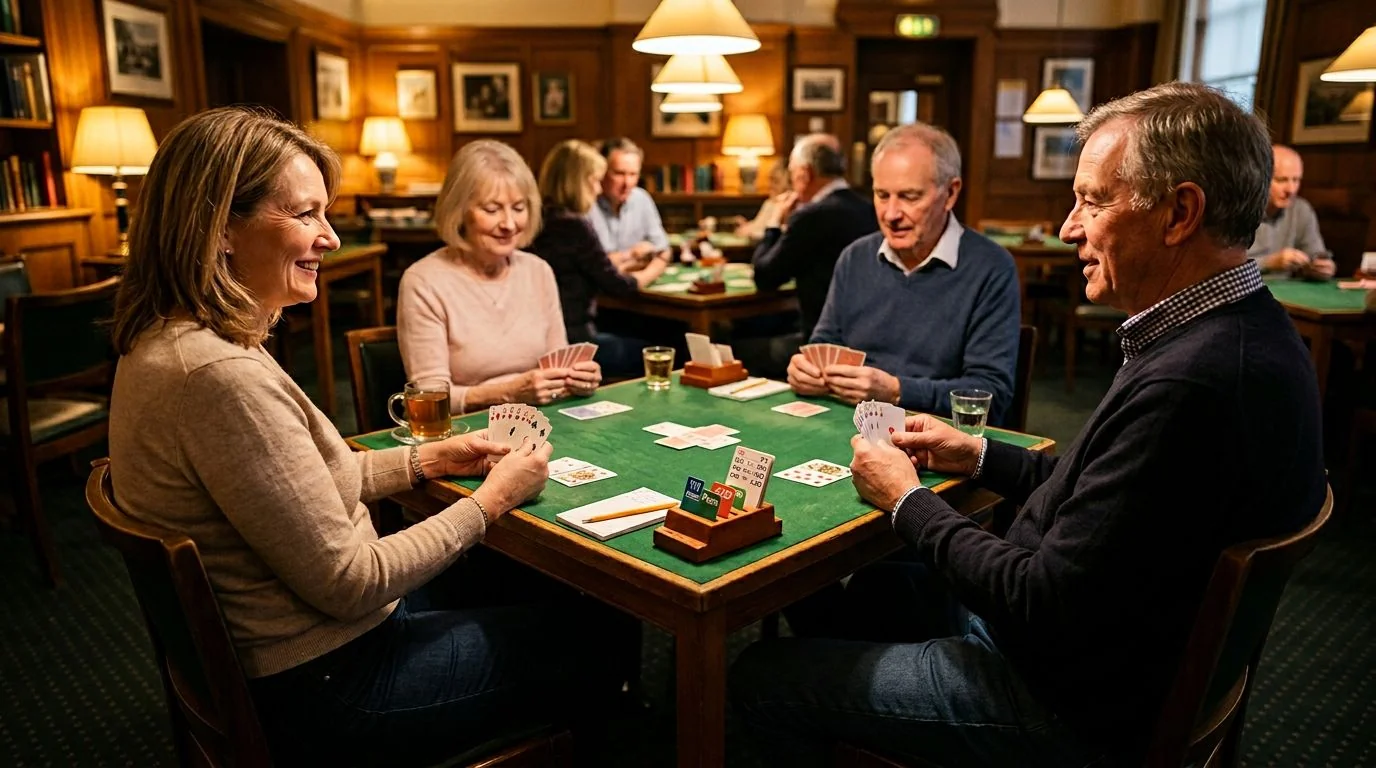
Sit down at a bridge table and something remarkable happens: nobody cares about the rest of your life.
You could be a CEO or a cashier. A college professor or a high school dropout. Retired military or never-employed. Gay, straight, trans, religious, atheist, Democrat, Republican.
None of it matters. The only thing that matters is how you play your 13 cards.
The Social Leveling
Bridge is one of the few spaces left where social hierarchy dissolves completely.
Your status gets checked at the door. Your job title means nothing. Your net worth doesn’t buy you better cards.
All that matters is whether you can count trumps, remember the auction, and figure out where the ♠Q is sitting.
That’s weirdly powerful.
Who You Meet at the Table
Look around your local bridge club and you’ll find:
– Retired engineers who spent 40 years designing airplanes
– Stay-at-home parents who needed an intellectual outlet
– Lawyers who wanted a game that wasn’t billable
– Teachers who finally found students who wanted to learn
– Kids (yes, kids) who are sharper than most adults
They wouldn’t normally occupy the same social circles. But at the bridge table? They’re equals.
And they respect each other—not because of external credentials, but because of how they play.
The Unspoken Code
Bridge culture has an unspoken rule: we don’t talk about the outside world.
You don’t ask people what they do for a living (unless they volunteer it).
You don’t brag about your portfolio or your kids’ Ivy League acceptances.
You don’t bring politics to the table. You don’t evangelize. You don’t lecture.
You talk about bridge. That’s the deal.
And it works. Because for two hours, everyone gets to exist in a world where the only hierarchy that matters is masterpoints and skill.
What Other Games Get Wrong
Poker has money. Chess has age divisions and ratings that create tiers. Video games have toxic chat and ranked ladders.
Bridge has none of that baggage. You sit down across from a stranger, and the only thing you know for sure is that they sorted their 13 cards just like you did.
Everything else is irrelevant.
The Real Community
Bridge clubs aren’t just places to play cards. They’re places where:
– A 75-year-old retiree can teach a 25-year-old software engineer how to play Bergen raises
– A nonbinary player can find a regular partner without anyone making it weird
– Someone who just lost their spouse can sit down and focus on something besides grief for two hours
– People who disagree about everything else can agree that you should always cover an honor with an honor
That’s the magic of the bridge table.
It’s the great equalizer.
The Bottom Line
If you’re looking for a space where you can be judged purely on merit, where your background doesn’t define you, and where the only question is “can you play?”—you’ll find it at a bridge table.
We could use more spaces like that in the world.
Luckily, we have this one.
—
Your turn: What’s the most unexpected friendship you’ve made at the bridge table? Or the most surprising person you’ve played with?
—
Meta:
– Word count: ~500 words
– Theme: Community/Social (Sunday)
– Voice: Reflective, inclusive, slightly idealistic but grounded
– Hook: Bridge as social equalizer
– CTA: Share unexpected bridge friendships
– SEO: Bridge community, bridge clubs, bridge culture, social aspects of bridge, inclusive bridge
– Human voice: Warm, personal, authentic
– Inclusivity: Deliberately inclusive language (LGBTQ+, socioeconomic diversity)
Practice What You've Learned with Brian
Brian is Bridgetastic's AI bidding coach. Deal real hands, get instant expert feedback on every bid, and build confidence — free to try, no partner needed.