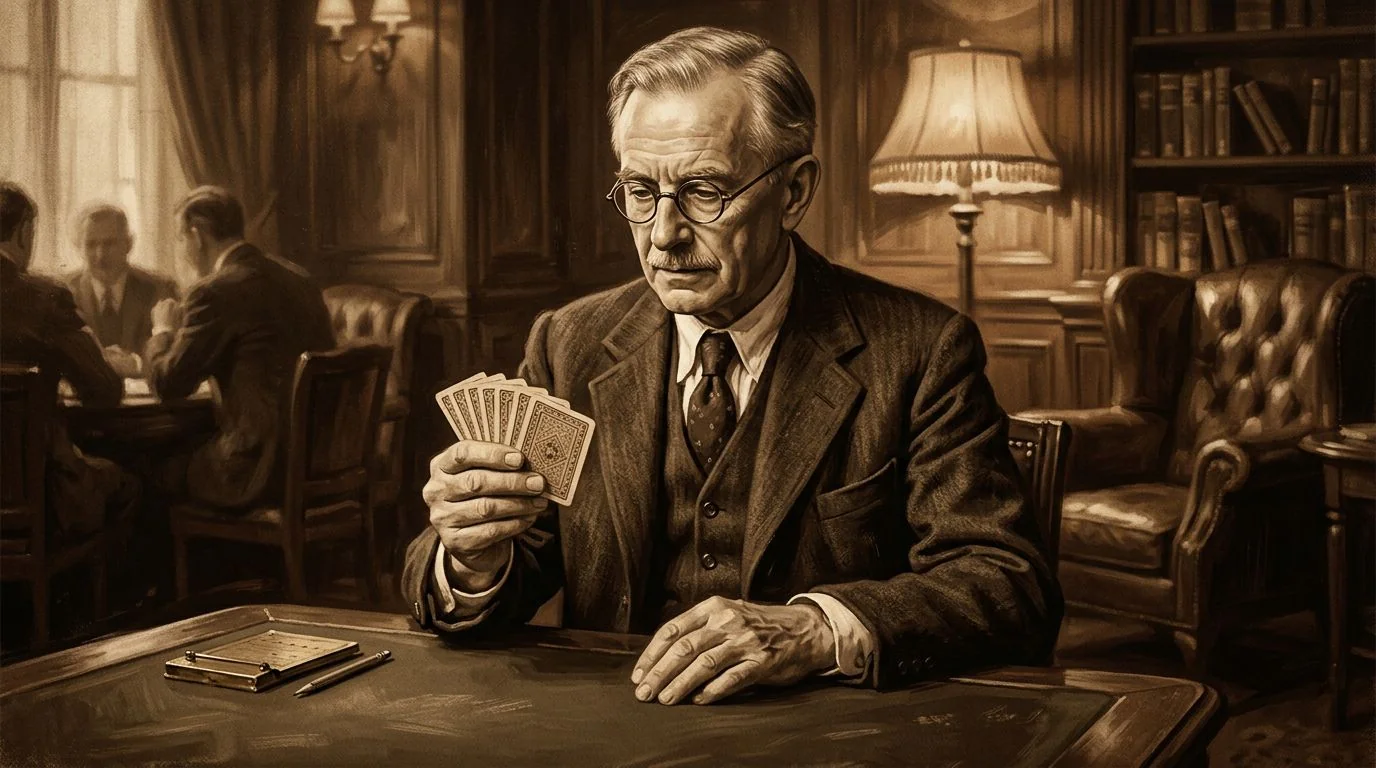
Every Wednesday night, my grandmother walked three blocks to Mrs. Henderson's house for bridge. Four women, same table, same chairs, for twenty-seven years. When Mrs. Henderson passed in 2018, they found scorecards dating back to 1991 tucked in her bridge table drawer.
That's bridge. A game that builds rituals, friendships, and communities that last decades. But how did a card game become this kind of cultural institution? The answer involves Russian aristocrats, explosive courtroom dramas, mathematical geniuses, and one crucial innovation that changed everything.
The Whist Foundation (17th-19th Century)
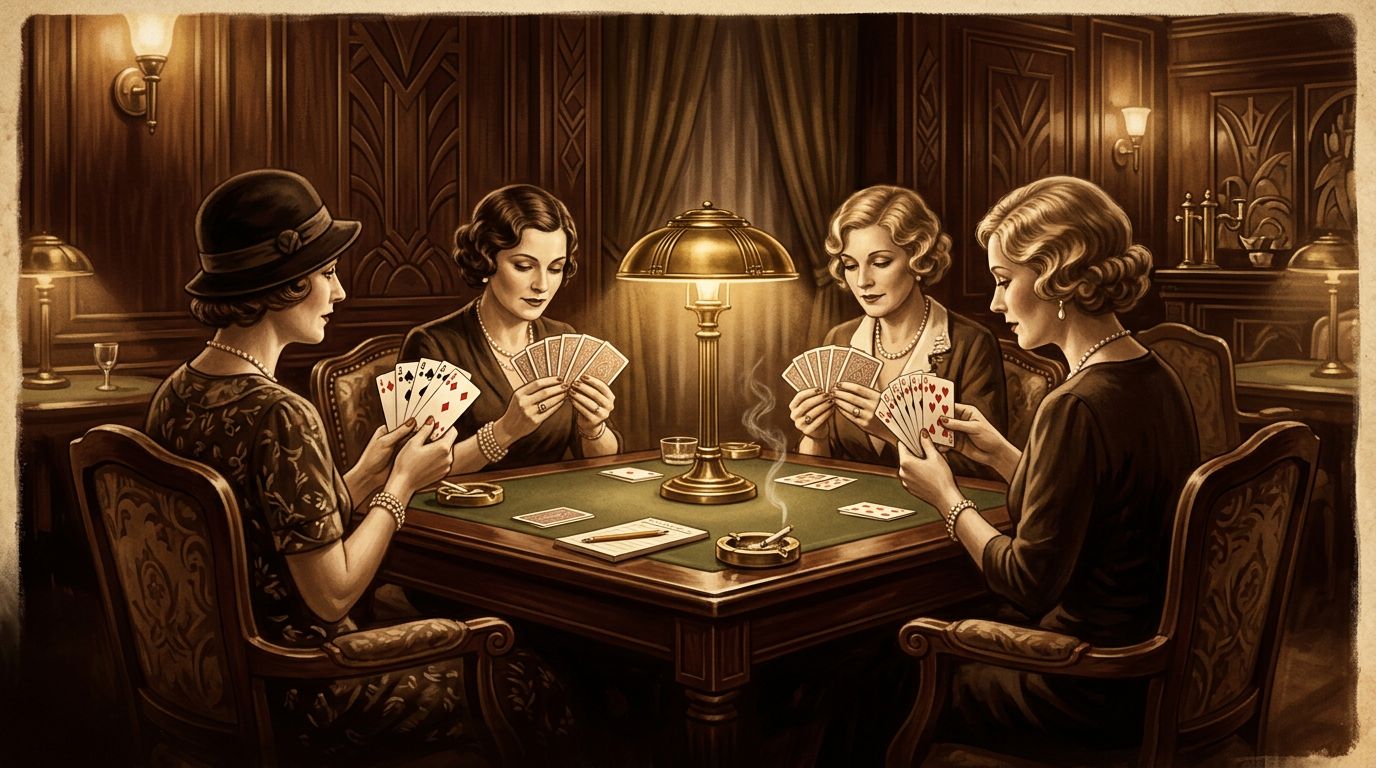
Bridge didn't appear out of nowhere. It evolved from whist, a trick-taking game played in England as early as the 1660s. Whist was simple: four players, partners sitting opposite, play to win tricks. Highest card in the suit led wins. Trump suit determined by the last card dealt.
What made whist special was the partnership element. Unlike poker (individual competition) or chess (one-on-one), whist required cooperation with a partner you couldn't speak to. Communication happened through the cards you played. That dynamic—reading your partner, building trust through plays rather than words—became the DNA of modern bridge.
By the mid-1800s, whist was everywhere in English-speaking countries. Clubs formed. Books were written. In 1862, Henry Jones (writing as "Cavendish") published The Laws of Whist, which standardized the game and elevated it from tavern pastime to respectable parlor entertainment.
The whist legacy in modern bridge:
- Partnership play — the core dynamic that makes bridge social and strategic
- Trump suits — still central to modern bidding and play
- Trick-taking mechanics — unchanged for 350+ years
- Social structure — clubs, regular games, competitive events
The Russian Connection: Biritch and Bridge Whist (1886-1904)
The game changed in the 1880s when a variant called "biritch" or "Russian whist" appeared in Constantinople and Paris. Nobody knows exactly who invented it, but the innovation was radical: before play began, players could bid for the right to name the trump suit.
Think about what this added. In regular whist, trump was random—whatever the last card happened to be. In biritch, you could choose based on your hand. If you had seven spades, you'd bid to make spades trump. This introduced strategy before the first card was played.
The game arrived in New York around 1893. By 1897, it had a new name: "bridge whist." Why "bridge"? Nobody knows for sure. The most popular theory: it was a corruption of "biritch," but that's just a guess.
What we do know: bridge whist caught on fast. By 1900, it was the fashionable game in New York society. Books appeared. Rules were published. The first American laws of bridge whist came out in 1903.
The Dummy Innovation
The key innovation in bridge whist was the introduction of the dummy hand. After the bidding, one player's hand was laid face-up on the table, and their partner played both hands.
This changed everything. In whist, you played blind—you knew your 13 cards and nothing else. In bridge, you could see 26 cards (your hand + dummy). This made the game deeper. You could plan. You could count. You could execute complex squeezes and endplays that were impossible when you couldn't see partner's cards.
The dummy also made bridge a better spectator sport. You could watch a hand develop and understand what the declarer was trying to do.
Auction Bridge: The Bidding Revolution (1904-1925)
Bridge whist was an improvement, but the bidding was primitive. The dealer got first bid, and whoever bid highest got to name trump and play the hand. Simple, but limited.
Around 1904, three British players in India—possibly John Collinson—developed "auction bridge." The innovation: competitive bidding. All four players could bid. You could outbid an opponent. You could show your strength through your bids.
This was the real revolution. Bidding became its own game—a language where you told partner what you held and decided together how high to bid. The tactics of modern bidding (showing suits, describing strength, finding fits) all emerged during the auction bridge era.
Auction bridge exploded in popularity. By 1912, it had completely replaced bridge whist in clubs and homes across America and Britain. This is when bridge became bridge—not just a whist variant, but its own game with its own culture.
The Flaw in Auction Bridge
But auction bridge had a problem: the scoring system was broken.
In auction bridge, you scored points for every trick you made, whether you bid it or not. So if you bid 3♠ and made 5♠, you got credit for all eleven tricks. This meant you could underbid your hand, make a bunch of extra tricks, and score huge points without risking anything.
Games were often decided by luck—who got the cards to make easy overtricks—rather than by bidding skill. The best players knew this was a problem, but nobody had figured out how to fix it.
Contract Bridge: The Modern Game Emerges (1925)
In 1925, Harold Vanderbilt was on a cruise ship from Los Angeles to Havana. He was a railroad heir, a skilled sailor, and an avid bridge player. During the voyage, he worked out a new scoring system that fixed auction bridge's biggest flaw.
The innovation: you only score points for the tricks you bid. If you bid 3♠ and make 5♠, you get credit for 3♠ plus a small bonus for the overtricks. But you don't get game credit unless you bid game.
This changed the entire game. Now you had to take risks. Underbidding didn't work anymore—you had to bid what you could make. Suddenly, bidding accuracy mattered more than conservative play.
Vanderbilt also introduced:
- Vulnerability — a rotating condition that increased penalties and bonuses, adding tactical depth
- Modern scoring values — game at 100+ points, slam bonuses, doubled contracts
- The concept of "game" and "part-score" — bidding targets that still define modern bridge
Vanderbilt called it "contract bridge." The name reflected the core innovation: you made a contract (a specific bid), and only that contract determined your score.
Why this mattered:
Contract bridge turned bidding into the heart of the game. In auction bridge, play was king—bidding was just a way to decide who played. In contract bridge, judging how high to bid became the essential skill. This is why modern bridge players spend years mastering bidding systems.
The Culbertson Era: Bridge Becomes Mass Culture (1930s-1940s)
Contract bridge might have stayed a society game if not for Ely Culbertson. Born in Romania, raised in Russia, educated in Paris, Culbertson arrived in New York in the 1920s with no money and big plans. He saw contract bridge and saw opportunity.
In 1930, Culbertson published The Blue Book, a comprehensive guide to contract bridge. But Culbertson wasn't just teaching bridge—he was building a media empire. He started a magazine (The Bridge World, still published today). He wrote newspaper columns. He gave lectures. He trained teachers.
Most importantly, he understood spectacle. In 1931, Culbertson challenged Sidney Lenz, another top player, to a high-stakes match. They played 150 rubbers over three months in a New York hotel, with journalists covering every session. Radio broadcasts. Daily newspaper updates. It was bridge as sports entertainment.
Culbertson won, and bridge exploded. By 1940, bridge was everywhere—in homes, clubs, schools, even in the military. It was estimated that 40 million Americans played bridge. That's roughly one in three adults.
The Culbertson vs. Goren Rivalry
But Culbertson had a problem: his bidding system was complicated. It worked, but learning it required dedication. Enter Charles Goren.
Goren was a lawyer who started playing tournament bridge in the 1930s. He refined Culbertson's methods, simplified them, and in 1949 published Point-Count Bidding. Instead of Culbertson's "honor tricks," Goren used a simple point system: A=4, K=3, Q=2, J=1.
This was genius marketing. Anyone could count to 40. You didn't need to memorize complex honor trick tables—just add up your points. By the mid-1950s, Goren had surpassed Culbertson as America's bridge authority. His books sold millions. His newspaper column reached 30 million readers.
For the next three decades, "Goren" was synonymous with bridge. If you learned bridge in America between 1950 and 1980, you learned Goren's system.
The Golden Age of American Bridge (1950s-1970s)
The 1950s through the 1970s were the golden age of American bridge. Tournaments drew thousands of players. The American Contract Bridge League (ACBL) grew from 30,000 members in 1950 to over 150,000 by 1970.
This era produced legendary players:
The Aces (1960s-1970s): A professional team funded by Texas businessman Ira Corn. They practiced full-time, developed new conventions, and dominated international competition. They won the Bermuda Bowl (world championship) in 1970 and 1971, ending a long drought for American teams.
The Italian Blue Team (1956-1975): The dominant force in world bridge. Giorgio Belladonna, Benito Garozzo, Pietro Forquet, and others won thirteen consecutive Bermuda Bowls. Their sophisticated systems (Roman Club, Precision Club) pushed bidding theory forward.
Omar Sharif: Yes, the actor. Sharif was a world-class bridge player who wrote columns, played in world championships, and brought celebrity attention to the game.
The 1975 Bermuda Bowl featured one of the most famous hands in bridge history—the "Ultimate Grand Slam Hand"—when Italy's Benito Garozzo and Giorgio Belladonna bid and made 7NT with only 24 combined high-card points against perfect defense. The hand is still studied today.
The Evolution of Bidding Systems (1960s-Present)
While Goren dominated American club bridge, tournament players were innovating. New bidding systems emerged:
1. Precision Club (1960s)
Developed by C.C. Wei in Taiwan. The innovation: 1♣ opening showed 16+ HCP (strong and artificial), freeing up other opening bids to describe hand types more precisely. The Italian Blue Team adopted Precision and dominated with it.
2. Two-Over-One Game Forcing (1970s-1980s)
Pioneered by Alvin Roth and others. In standard Goren methods, a 2-level response (like 1♠—2♥) was forcing for one round but didn't promise game. In 2/1, that same bid guaranteed the partnership would reach game, allowing more efficient bidding.
By the 2000s, Two-Over-One had become the standard system for serious American players. Most tournament players today use some variant of 2/1.
3. Modern Relay Systems (1990s-Present)
Advanced methods where one partner asks a series of artificial questions (relays) and the other describes their hand in detail. These systems are incredibly precise but require extensive partnership practice.
The Computer Age (1990s-Present)
Computers changed bridge in two major ways:
1. Analysis Tools
Programs like Bridge Baron, GIB, and later BridgeBase could analyze hands and determine optimal play. Suddenly, you could know with certainty whether a contract should make. This raised the level of play—top players could study thousands of hands and learn from computer-perfect analysis.
2. Online Bridge
BridgeBase Online (BBO), launched in 2001, allowed players worldwide to play bridge 24/7. No need for a club or a regular foursome. Within a decade, BBO had hundreds of thousands of users.
The pandemic accelerated this shift. When clubs closed in 2020, online bridge kept the game alive. Many clubs now run hybrid events—some players in person, others online.
Modern Competitive Bridge (2000s-Present)
Today's bridge world is more international and more professional than ever:
World Championships: The Bermuda Bowl, Venice Cup (women's), and other world events draw teams from 50+ countries. Prize pools have increased. Sponsorship exists. Some top players make a living from bridge.
Cheating Scandals: The 2015 Lotan Fisher and Ron Schwartz scandal (proven to be passing signals about their hands) and the 2016 Fantoni-Nunes case shocked the bridge world and led to lifetime bans and stricter monitoring.
Aging Demographic: The game faces a challenge—the average age of ACBL members is over 70. Youth programs exist, but bridge competes with video games, esports, and other entertainment options.
Bridge in Education: Some schools teach bridge as part of math or critical thinking curricula. Research suggests bridge improves cognitive skills, memory, and problem-solving.
Why Bridge Endures
Bridge has survived for over a century while other games faded. Why?
Infinite depth: You can play for fifty years and still encounter new situations. The game rewards study, practice, and pattern recognition in ways that pure luck games don't.
Social structure: Bridge builds communities. Regular partnerships. Club friendships. Tournament rivalries. It's not just a game—it's a social ecosystem.
Partnership dynamics: Unlike chess or poker, bridge is fundamentally cooperative. You succeed or fail with a partner. This creates unique psychological dynamics—trust, communication, shared accomplishment—that individual games can't match.
Accessibility: You can play bridge at any level. A beginner's game is just as valid as a world championship. The rules don't change based on skill.
What's Next?
Bridge is at a crossroads. The traditional club model is fading. But online play is thriving. Younger players exist, but in smaller numbers.
What might save bridge—or transform it—is the same thing that's transforming everything else: AI.
Programs like Brian can teach bidding, analyze hands, and provide personalized coaching at a scale that human teachers can't match. A beginner can get expert-level feedback instantly. An intermediate player can study specific situations.
If bridge can combine its rich tradition with modern technology—keeping the social elements that make it special while making it easier to learn and play—it could thrive for another hundred years.
My grandmother's bridge group eventually found a fourth to replace Mrs. Henderson. They still play every Wednesday. The game continues.
Want to Join the Next Chapter of Bridge History?
Whether you're a complete beginner or looking to sharpen your bidding, Brian offers personalized AI coaching that adapts to your skill level. Learn conventions, practice bidding, and get instant feedback—all on your schedule.
Try Brian Free →