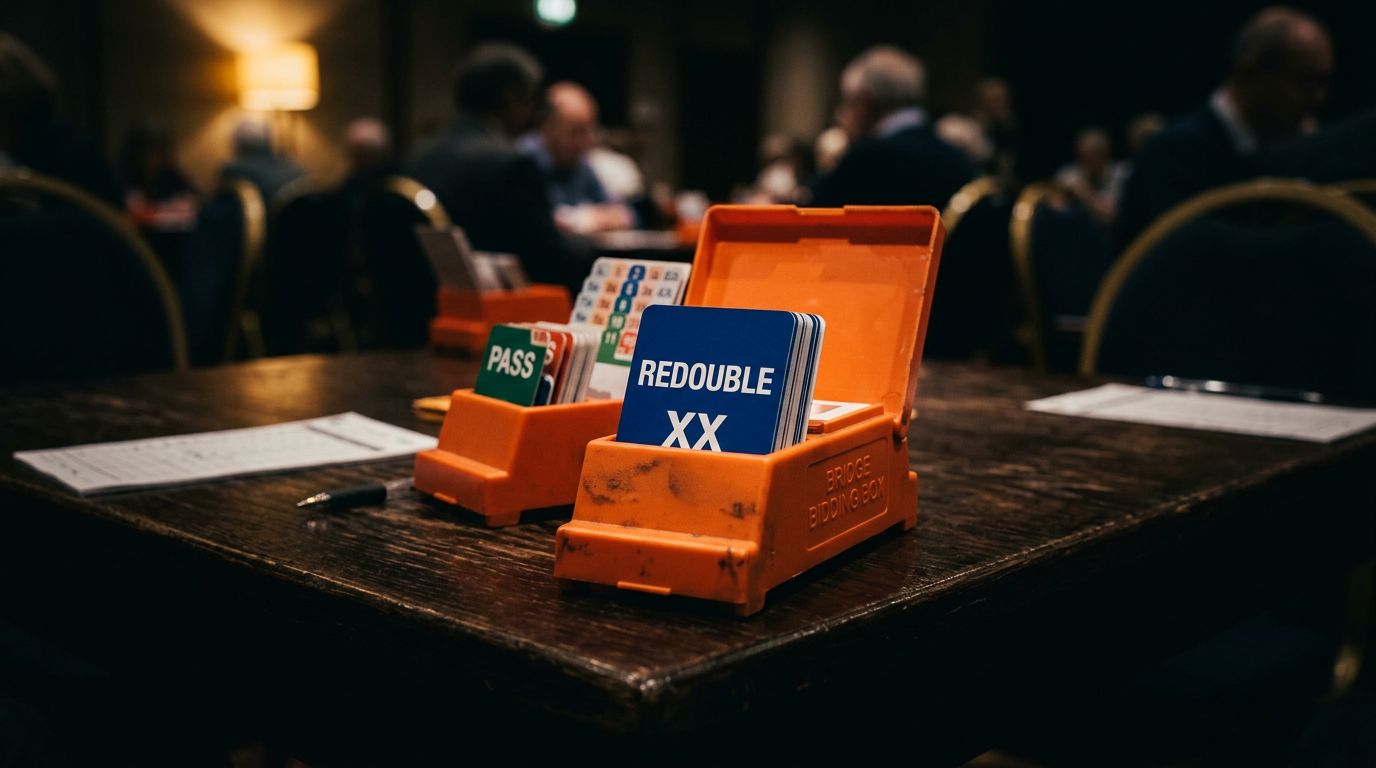
Redoubles: The Most Versatile Call in Bridge
The redouble is bridge’s most misunderstood call. It takes up no bidding space, yet it can mean entirely different things depending on context. One auction, it’s a cry for help. Another, it’s a show of strength. In slam bidding, it can pinpoint specific controls. Understanding when and how to use redoubles, and critically, when NOT to, separates intermediate players from advancing competitors.
When Harold Vanderbilt invented the redouble in 1925, he intended it to quadruple the score. But bridge players quickly discovered that this rare call was far more valuable as a tool for communication. Today, most redoubles are artificial, conveying specific messages about hand strength, distribution, or controls. The problem? There are multiple meanings, and choosing the wrong one can turn a making contract into a disaster.
In this guide, you’ll learn every major use of the redouble: the SOS rescue, the strength-showing redouble, control-showing redoubles in slam auctions, the Rosenkranz convention, and when to simply avoid redoubling altogether. Each has distinct requirements, and recognizing the context is essential.
The Strength-Showing Redouble
This is the most common type of redouble you’ll encounter. It occurs when partner opens the bidding and your right-hand opponent makes a takeout double.
Requirements:
- 10+ high-card points
- Partner has opened the bidding
- RHO made a takeout double (not a penalty double)
What it means: “This hand belongs to our side. We have the majority of the high-card points.”
The strength-showing redouble sends a clear message: your side holds at least half the deck’s strength, often more. It sets up a penalty situation, any subsequent double by either you or partner is for penalty, not takeout. The redouble forces the opponents to bid, giving you the opportunity to penalize them when they find their fit.
Example: Classic Strength-Showing Redouble
Auction:
West    North   East    South
        1♦      Dbl     Rdbl
Your hand (South):
♠K1086
♥A2
♦KJ63
♣AQ6
Hand count: 4 + 2 + 4 + 3 = 13 cards ✓
HCP: K(3) + 10(0) + 8(0) + 6(0) = 3; A(4) + 2(0) = 4; K(3) + J(1) + 6(0) + 3(0) = 4; A(4) + Q(2) + 6(0) = 6 → Total: 17 HCP ✓
You have 17 HCP, well above the 10-point minimum. Your redouble tells partner you’re looking to penalize the opponents. If they bid hearts, you can double for penalty with your strong defensive values.
Planning Your Rebid
A redouble isn’t recommended with just any 10 points. Consider how you’ll continue after the opponents run to a suit. The redouble works best when your hand fits one of three strategies:
1. You plan to double their runout
You have shortness in partner’s suit and strong holdings in at least two unbid suits. This is especially attractive when the opponents are vulnerable.
2. You plan to bid notrump
You have 10+ points with balanced distribution in the unbid suits. You’ll steer toward notrump rather than double if your holdings aren’t strong enough for penalty, particularly when opponents are non-vulnerable.
3. You plan to raise partner
A redouble followed by a minimum raise shows invitational values (11-12 support points) with moderate trump support (3 cards for a major, 4-5+ for a minor).
Example auction:
Partner   RHO     You     LHO
1♥        Dbl     Rdbl    1♠
Pass      Pass    2♥
This sequence shows 11-12 support points with 3-card heart support. Partner can pass with a minimum opener.
The SOS Redouble (Rescue)
Also called the “Save Our Ship” redouble, this is the opposite of the strength-showing redouble. It’s a desperate plea: “Get me out of this contract immediately!”
Requirements:
- Partner’s bid has been doubled for penalty
- You have extreme shortness (0-2 cards) in partner’s suit
- You have length in all unbid suits
- The auction is at a low level
What it means: “This doubled contract will be a disaster. Please bid your longest suit.”
The SOS redouble applies when it’s obvious to partner that you could be very short in his suit. The most common situation is when partner opens a short minor (1♣ or 1♦) and the opponents leave in a takeout double for penalty.
Example: Classic SOS Redouble
Auction:
West    North   East    South
        1♣      Dbl     Pass
Pass    Pass    Rdbl
Your hand (South):
♠AQ8
♥K864
♦1054
♣J92
Hand count: 3 + 4 + 3 + 3 = 13 cards ✓
HCP: A(4) + Q(2) + 8(0) = 6; K(3) + 8(0) + 6(0) + 4(0) = 3; 10(0) + 5(0) + 4(0) = 0; J(1) + 9(0) + 2(0) = 1 → Total: 10 HCP ✓
Your right-hand opponent has converted partner’s takeout double to penalty by passing—they have long, strong clubs. You have only three small clubs and will be destroyed in 1♣ doubled. Your redouble asks partner to rescue you by bidding their longest suit.
When SOS Applies
The SOS redouble is contextual. Partner must be able to tell from the auction that you’re in trouble. Common situations:
- Partner opens 1♣ or 1♦, LHO doubles, and it’s passed back to you
- Partner opens 1NT, LHO doubles, and it’s passed back to you (in passout seat only)
- Any low-level contract where you’ve shown no fit and the opponents have doubled for penalty
If you’ve already shown support for partner’s suit, a redouble is NOT SOS, it has a different meaning (often showing a control or extra strength).
Example: NOT an SOS Redouble
Auction:
West    North   East    South
        1♠      Dbl     2♠
Dbl     Pass    Pass    Rdbl
This is NOT SOS because you already raised spades to 2♠, showing support. This redouble would have a different conventional meaning (perhaps showing first-round control, depending on partnership agreement). An SOS redouble requires that you haven’t shown a fit.
The Rosenkranz Redouble
The Rosenkranz convention, named after Mexican expert George Rosenkranz, is an advanced tool used in competitive auctions after partner overcalls.
Requirements:
- Partner has overcalled
- RHO makes a bid (typically a new suit or negative double)
- You have 3-card support for partner’s suit
- You hold at least one of the top three honors (A, K, or Q) in partner’s suit
- You have 6-10 points
What it means: “I have 3-card support with a top honor. This helps you on defense and in competitive bidding decisions.”
When you hold the same support but WITHOUT a top honor, you make a direct raise instead. This distinction helps partner judge whether to compete further and how to defend if the opponents win the auction.
Example: Rosenkranz Redouble
Auction:
West    North   East    South
1♦      1♠      Dbl     Rdbl
Your hand (South):
♠K73
♥83
♦KQ93
♣10873
Hand count: 3 + 2 + 4 + 4 = 13 cards ✓
HCP: K(3) + 7(0) + 3(0) = 3; 8(0) + 3(0) = 0; K(3) + Q(2) + 9(0) + 3(0) = 5; 10(0) + 8(0) + 7(0) + 3(0) = 0 → Total: 8 HCP ✓
Your redouble shows 3-card spade support with a top spade honor (the king). If East had passed instead of doubling, you would double to show the same hand.
Example: Simple Raise (No Top Honor)
Auction:
West    North   East    South
1♦      1♠      Dbl     2♠
Your hand (South):
♠9873
♥AK5
♦J109
♣965
Hand count: 4 + 3 + 3 + 3 = 13 cards ✓
HCP: 9(0) + 8(0) + 7(0) + 3(0) = 0; A(4) + K(3) + 5(0) = 7; J(1) + 10(0) + 9(0) = 1; 9(0) + 6(0) + 5(0) = 0 → Total: 8 HCP ✓
You have 4-card spade support (even better than 3) but no top spade honor. You raise to 2♠ directly rather than redouble. This tells partner not to expect the king, queen, or ace of spades in your hand.
Rosenkranz Through the 2-Level
Rosenkranz doubles and redoubles apply only through the 2-level, when you have the choice to either (re)double or raise partner’s suit to the 2-level. With 10+ points and support, you should cuebid instead to show your stronger hand.
Control-Showing Redoubles
In slam auctions, when an opponent doubles a cuebid, a redouble shows first-round control (ace or void) in the doubled suit.
Requirements:
- You’re in a slam-going auction
- Partner or you have made a cuebid
- An opponent doubles that cuebid
- You haven’t yet shown first-round control in that suit
What it means: “I have first-round control (ace or void) in the doubled suit.”
This is particularly useful in Italian-style slam bidding, where opponents sometimes double cuebids to disrupt your control-showing sequence. The redouble allows you to show your ace or void without using bidding space.
Example: Control-Showing Redouble
Auction:
West    North   East    South
                        1♠
Pass    3♠      Pass    4♣
Pass    4♦      Dbl     Rdbl
Your hand (South):
♠AKJ105
♥K5
♦AQ84
♣K2
Hand count: 6 + 2 + 4 + 2 = 14 cards… A, K, J, 10, 5 = 5 spades. 5 + 2 + 4 + 2 = 13 cards ✓
HCP: A(4) + K(3) + J(1) + 10(0) + 5(0) = 8; K(3) + 5(0) = 3; A(4) + Q(2) + 8(0) + 4(0) = 6; K(3) + 2(0) = 3 → Total: 20 HCP ✓
You opened 1♠, partner made a splinter raise (3♠), and you cuebid 4♣ showing the club king. Partner cuebid 4♦, which East doubled. Your redouble shows first-round diamond control (the ace). This helps partner evaluate if slam is safe.
If you passed instead of redoubling, it would typically deny first-round control (showing second-round control, the king, or no control at all, depending on your partnership agreements).
Redoubles in Competitive Auctions
Beyond the specific conventional meanings, redoubles can occur in various competitive situations. The key is understanding the context.
After a Penalty Double of Your Game
If your side voluntarily bids a game and an opponent makes a penalty double, a redouble suggests they’ve made a mistake. You believe you’ll make your contract and want the increased score.
Warning: This is rare and risky. Even if you’re confident, the redouble keeps the auction open and may scare the opponents into running to their own contract. Use cautiously!
After a Negative Double
When partner opens, RHO overcalls, and you make a negative double, if the next opponent redoubles, it typically shows a strong hand with length in your implied suit(s).
The “Business” Redouble
The original purpose, redoubling for an increased score, still exists but is extremely rare. It should only be used when you’re absolutely certain the opponents have made an error and you want to maximize your score.
When NOT to Redouble
The strength-showing redouble isn’t automatic just because you have 10+ points. Many hand types are better described with natural bidding.
Hands with Long Suits
Example:
Auction:
Partner   RHO     You     LHO
1♦        Dbl     ?
Your hand:
♠4
♥AJ872
♦Q54
♣KJ63
Hand count: 1 + 5 + 3 + 4 = 13 cards ✓
HCP: 4(0) = 0; A(4) + J(1) + 8(0) + 7(0) + 2(0) = 5; Q(2) + 5(0) + 4(0) = 2; K(3) + J(1) + 6(0) + 3(0) = 4 → Total: 11 HCP ✓
You have 11 HCP, enough to redouble. But if you redouble, you force the opponents to bid spades (their likely fit). The auction might reach 2♠ or higher before it’s your turn again. Now you have to search for a trump suit at the 3-level with no guarantee partner has a fit.
Better bid: 1♥
Bidding 1♥ over the double doesn’t deny 10+ points. It’s forcing for one round, and you can show your strength later. This “ignore the double” approach keeps the auction at a manageable level and begins describing your distribution immediately.
Hands with Strong Support
Example:
Auction:
Partner   RHO     You     LHO
1♥        Dbl     ?
Your hand:
♠82
♥KJ94
♦AQ73
♣1065
Hand count: 2 + 4 + 4 + 3 = 13 cards ✓
HCP: 8(0) + 2(0) = 0; K(3) + J(1) + 9(0) + 4(0) = 4; A(4) + Q(2) + 7(0) + 3(0) = 6; 10(0) + 6(0) + 5(0) = 0 → Total: 10 HCP ✓
You have exactly 10 HCP with 4-card heart support. While you could redouble, it’s often more effective to show your heart fit immediately. Many partnerships use Jordan 2NT (a jump to 2NT showing a limit raise or better) in this auction. Alternatively, you can use a simple 3♥ raise (preemptive) or redouble followed by a raise (invitational).
The key point: when you have 4+ card support for partner’s major, consider showing it immediately rather than redoubling first. The fit is your most important feature.
Weak Hands Searching for a Fit
Even with fewer than 10 HCP, you may need to bid over a double to compete for the auction.
Example:
Auction:
Partner   RHO     You     LHO
1♣        Dbl     ?
Your hand:
♠54
♥Q873
♦A754
♣Q84
Hand count: 2 + 4 + 4 + 3 = 13 cards ✓
HCP: 5(0) + 4(0) = 0; Q(2) + 8(0) + 7(0) + 3(0) = 2; A(4) + 7(0) + 5(0) + 4(0) = 4; Q(2) + 8(0) + 4(0) = 2 → Total: 8 HCP ✓
If you pass, the opponents will likely bid spades and shut you out. Respond 1♥ to compete. Partner won’t raise hearts without 4-card support (or possibly strong 3-card support with a ruffing value). Your 1-level bid doesn’t promise a 5-card suit when RHO has doubled—you’re simply searching for a fit.
Modern Practice and Partnership Agreements
Redoubles are one of the most partnership-dependent areas of bridge. Here are key agreements to discuss:
1. Strength-Showing Redouble Minimums
Standard: 10+ HCP
Some aggressive partnerships: 9+ HCP
Conservative partnerships: 11+ HCP
Discuss with your partner what your minimum is.
2. After Your Redouble
When you redouble and partner bids a new suit:
- Most partnerships: Partner’s new suit is not forcing (they may be weak and running from penalty)
- Some partnerships: Partner’s new suit is forcing for one round
Clarify this before it matters!
3. Rosenkranz On or Off
Many intermediate partnerships don’t use Rosenkranz at all. If you want to use it:
- Confirm it applies only through the 2-level
- Confirm whether it applies after partner’s 1NT overcalls
- Confirm whether you play Rosenkranz doubles as well as redoubles
4. Support Redoubles
Some partnerships use a redouble after (1m)–X–(P)–P to show specifically 3-card support for partner’s minor (rather than general strength). This is called a “support redouble” and is completely different from the strength-showing redouble.
Example auction:
Partner   RHO     You     LHO
1♦        Dbl     Pass    Pass
Rdbl
Playing support redoubles, partner’s redouble here would show exactly 3 diamonds (if they had 4+, they might pass or bid differently). This is an advanced agreement, make sure your partner knows if you’re using it!
5. Control-Showing in Slam Auctions
After an opponent doubles a cuebid:
- Redouble: First-round control (ace or void)
- Pass then pull: Second-round control (king or singleton)
- Pass and defend: No control
This is standard in expert partnerships but should be confirmed.
Common Mistakes
Redoubling with Unsuitable Hands
The biggest error is redoubling with 10 points when your hand doesn’t fit the three rebid strategies (doubling their runout, bidding notrump, or raising partner). If you can’t visualize a sensible continuation, bid naturally instead.
Forgetting the Context
Not every redouble is strength-showing! Look at the entire auction:
- After your opening is doubled → strength-showing
- After a penalty double of a low-level contract with no fit shown → SOS
- After partner overcalls and RHO doubles → Rosenkranz (if playing it)
- After opponent doubles a cuebid in a slam auction → control-showing
Redoubling for Business When It’s Artificial
If you hold:
♠K4
♥QJ1096
♦A83
♣762
And the auction goes:
Partner   RHO     You     LHO
1♥        Dbl     ?
Don’t redouble thinking “we can make this redoubled!” Your redouble here is strength-showing (10+ HCP), not a business redouble. If you want to defend 1♥ doubled, just pass. Partner will usually pass as well with a minimum opener, and you’ll play it right there.
Summary Table
| Auction Context | Redouble Meaning | Requirements |
|---|---|---|
| Partner opens, RHO doubles | Strength-showing | 10+ HCP, no extreme distribution |
| Low-level contract doubled for penalty, no fit shown | SOS (rescue) | 0-2 cards in partner’s suit, length elsewhere |
| Partner overcalls, RHO doubles/bids | Rosenkranz (if playing) | 3-card support, top honor, 6-10 HCP |
| Slam auction, opponent doubles cuebid | Control-showing | First-round control in doubled suit |
| Game contract doubled by opponents | Business (rare) | Confidence you’ll make it |
Practice This Convention with Brian
Want to test your understanding of this convention in realistic hands? Brian, the Bridgetastic AI, can deal you practice hands, walk you through the bidding, and explain when this convention applies, and when it doesn’t. Try Brian free →
Key Takeaways
-
Context is everything. The same call (redouble) has completely different meanings in different auctions. Always look at the full auction before deciding what a redouble means.
-
10+ points doesn’t automatically mean redouble. Consider your rebid plan. If you have a long suit, support for partner, or an unbalanced hand, natural bidding is often better.
-
SOS redoubles are rare but crucial. When you’re doubled in a misfit contract at a low level, the redouble is your escape hatch. But partner must be able to read the context, if you’ve shown support, it’s not SOS.
-
Discuss with your partner. Redoubles are partnership-dependent. Confirm your agreements on strength-showing minimums, Rosenkranz (on/off), support redoubles, and slam auction meanings.
-
When in doubt, bid naturally. If you’re uncertain what a redouble would mean or whether it’s the right call, make a natural bid instead. Describing your hand clearly is more important than using every conventional tool in the box.
Master the redouble, and you’ll have a powerful weapon for both constructive and competitive auctions. Misuse it, and you’ll turn makable contracts into disasters. Understanding the context, and knowing when NOT to redouble, is what separates the good players from the great ones.