The Mississippi Heart Hand: The Classic Cheating Deal
Take the ♥A-K-Q-J-10-9-8-7-6-5-4-3-2. Now deal them so every player gets 13 hearts. Sounds impossible, right?
It is. But that’s the Mississippi Heart Hand, and it’s been fooling people for over a century.
The Deal
Here’s what it looks like:
        North
        ♠ none
        ♥ A K Q J 10 9 8 7 6 5 4 3 2
        ♦ none
        ♣ none

West                    East
♠ none                 ♠ none
♥ A K Q J 10 9 8 7 6 5 4 3 2  ♥ A K Q J 10 9 8 7 6 5 4 3 2
♦ none                 ♦ none
♣ none                 ♣ none

        South
        ♠ none
        ♥ A K Q J 10 9 8 7 6 5 4 3 2
        ♦ none
        ♣ none
Wait. That’s 52 hearts. In a 52-card deck.
Exactly.
The Story
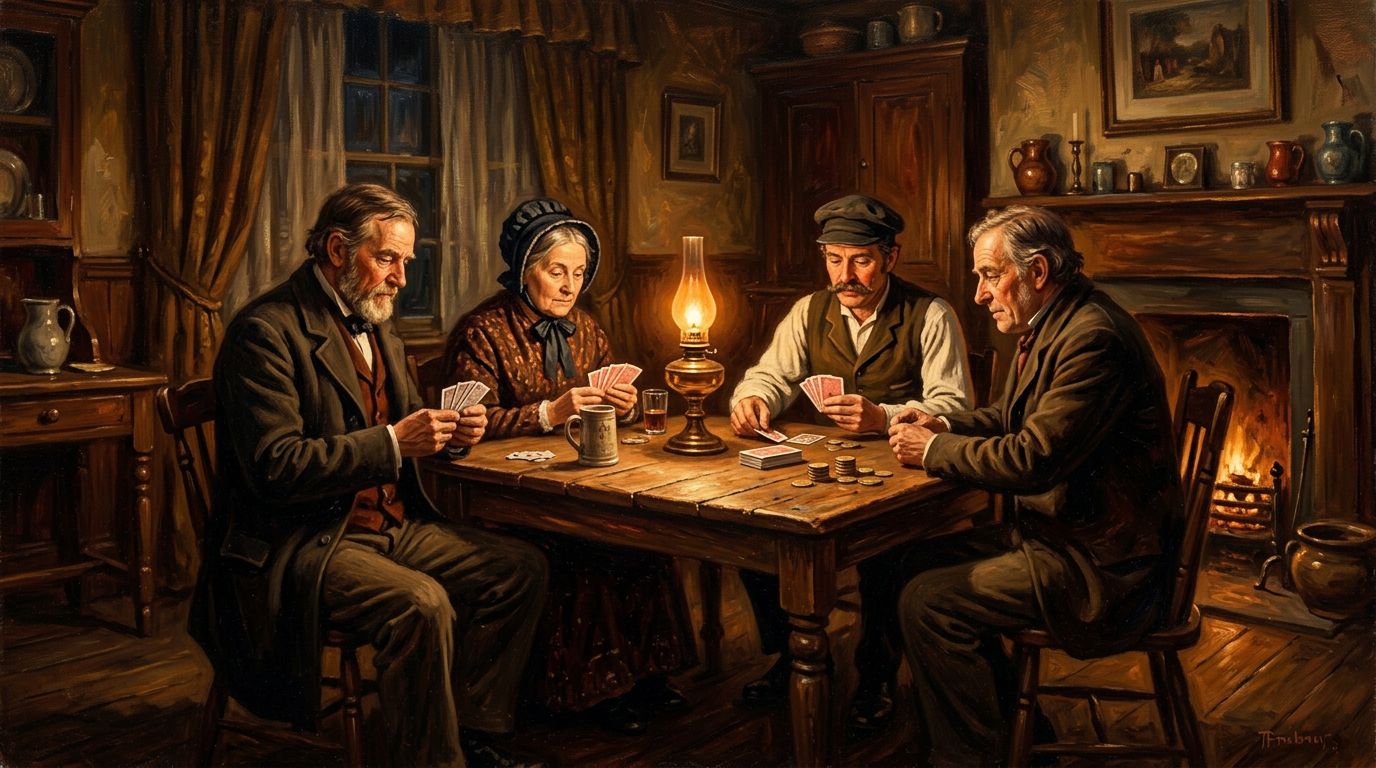
The name comes from riverboat gamblers on the Mississippi River in the late 1800s. The story goes that a con man would produce this deal to demonstrate “how cards can fall naturally.” He’d deal out the hand, everyone would gasp, and he’d use it to prove that any distribution is possible.
Then he’d suggest a friendly game of cards. After all, if 52 hearts can appear naturally, who’s to say what hands might come up?
Of course, the Mississippi Heart Hand never came up. But marks who’d just seen an “impossible” deal shuffle out naturally were primed to believe anything could happen. Even when it kept happening to cost them money.
The beauty of the con is that it’s not actually a playable hand. It’s a demonstration. Theater. You show the deal, prove you didn’t cheat (everyone counts their 13 hearts), and then shuffle and deal a normal game. Where you absolutely are cheating.
Why It’s Impossible
The odds of dealing this hand naturally are so small they might as well be zero. We’re talking about 1 in 53,644,737,765,488,792,839,237,440,000 (that’s 53 octillion).
For perspective, if you dealt a bridge hand every second since the Big Bang, you wouldn’t have come close to seeing the Mississippi Heart Hand occur naturally.
But here’s the thing: players know this. Even in the 1800s, gamblers understood the odds. That’s not why the demonstration works.
It works because seeing something impossible makes you question your assumptions. If this can happen, what else can happen? And once your certainty cracks, you’re vulnerable.
How It’s Done
You need a stacked deck. The most common method:
Take all 13 hearts. Put them on top of the deck. Do an overhand shuffle that keeps them together but looks natural. Then do a perfect faro shuffle (alternating cards from each half of the deck).
With the right setup and two faro shuffles, you can distribute 13 hearts to each player. The shuffle looks fair. The deal looks fair. The result looks impossible.
Modern magicians still use variations of this. It’s not about fooling professionals. It’s about creating a moment of wonder (or doubt) that serves a larger purpose.
The Bridge Connection
This hand has nothing to do with real bridge. You can’t bid it, can’t play it, can’t learn anything from the card play. It’s pure stunt.
But every bridge player knows about it. Why?
It’s a cautionary tale. This is what a stacked deck looks like. If you ever see something this weird, you’re being hustled.
It proves shuffling matters. A properly shuffled deck won’t produce this. Not in a trillion years. So if it does appear, someone didn’t shuffle properly. Or didn’t shuffle honestly.
It’s a teaching tool. Bridge teachers use it to explain probability. Students see this hand and understand why random distribution is, well, random. Extreme patterns don’t happen.
It’s fun. Come on. Dealing out 52 hearts to four players is funny. People remember it. And remembering improbable hands helps you recognize probable ones.
Variations
The Mississippi Heart Hand has cousins:
The Bridge Whist Coup. Four hands where each player holds all 13 cards of one suit. Same principle, different arrangement.
The Perfect Deal. Each player gets one ace, one king, one queen, one jack, and nine other cards in perfect sequence. Less dramatic than all hearts, but still proof of stacking.
The Bust-Out Hand. Used in poker and bridge. Each player gets a great hand, but one player gets the nuts. Everyone bets heavy, one player cleans up. Classic cheating setup.
All of these hands exist to separate marks from money. And they all work the same way: create an impossible situation, normalize it, then exploit the confusion.
Real-World Cheating
Actual bridge cheaters don’t use the Mississippi Heart Hand. It’s too obvious.
Real cheating is subtle. A partnership signals information through tempo, position, or illegal communication. They don’t need stacked decks when they can signal the ♥K location across the table.
But the principle is the same. Create an information advantage, exploit it, and hope nobody notices.
The Mississippi Heart Hand is what cheating looks like when you don’t care about getting caught. It’s a demonstration, not a strategy. And that’s exactly why it’s famous.
Why It Still Shows Up
Bridge clubs still demonstrate this hand. Teachers set it up for students. Players joke about it when someone pulls a random 13-0 distribution from the shoe.
It’s not relevant to modern bridge. But it’s part of bridge culture. Everyone knows the hand, everyone knows it’s fake, and everyone understands what it represents.
Cheating has been part of card games since cards were invented. The Mississippi Heart Hand is just the most honest version. It doesn’t pretend to be real. It shows you the trick, then dares you to fall for it anyway.
And people do. Not because they believe the cards fell that way. But because once you’ve seen the impossible, the merely improbable seems reasonable.
That’s the real lesson of the Mississippi Heart Hand. It’s not about the cards. It’s about confidence. Show someone something unbelievable, and they’ll start believing everything. Even when they shouldn’t.
What to Remember
This hand is impossible naturally. If you see it, someone stacked the deck.
Probability matters. Wildly uneven distributions don’t happen. 7-3 breaks are common, 8-2 breaks happen, 13-0 breaks don’t.
Shuffling protects you. A proper shuffle randomizes the deck. Always shuffle thoroughly. Always.
Spectacle covers deception. The flashier the trick, the more you should question it.
Real cheating is subtle. If you’re worried about cheating at the table, watch for signals and timing, not stacked decks.
The Mississippi Heart Hand isn’t a bridge hand. It’s a magic trick dressed as a card game. And like all good magic, it works because people want to believe.
Don’t believe it. Shuffle your cards.
The Bottom Line
You’ll never see this deal happen naturally. Not in your lifetime, not in a thousand lifetimes. The math doesn’t allow it.
But you should know about it. Because understanding what’s impossible helps you recognize what’s merely unlikely. And in bridge, that distinction matters.
Plus, it’s a great story. Four players, 52 hearts, and a con man laughing all the way to the bank. That’s bridge history, even if it’s not bridge strategy.
Every serious player knows this hand. Now you do too.