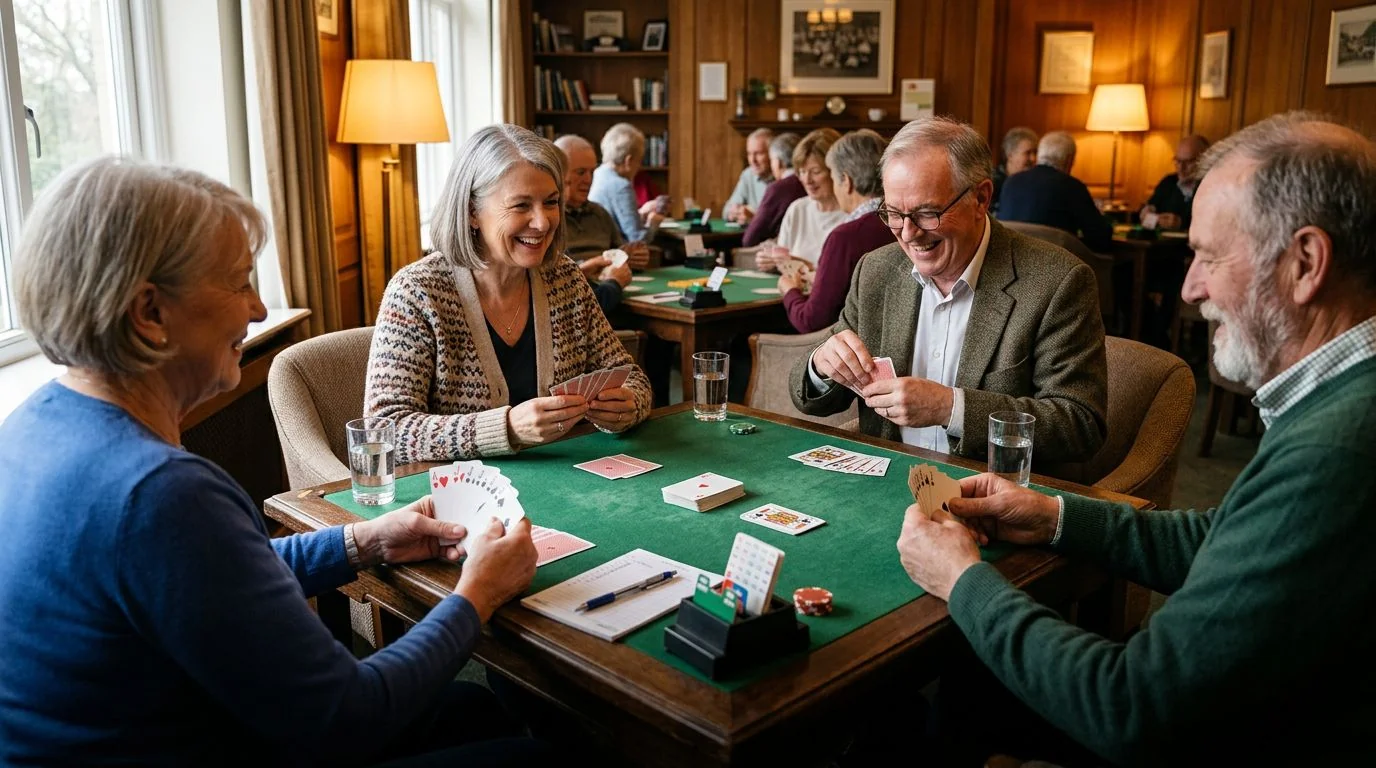
Bridge is the most popular card game in the world among serious players. Played by over 25 million people globally, it combines strategy, partnership, and social connection in a way no other game matches. If you've been curious about bridge but intimidated by its reputation for complexity, this guide will get you started.
By the end of this article, you'll understand how bridge works, what makes it different from other card games, and how to play your first hand.
What Is Bridge?
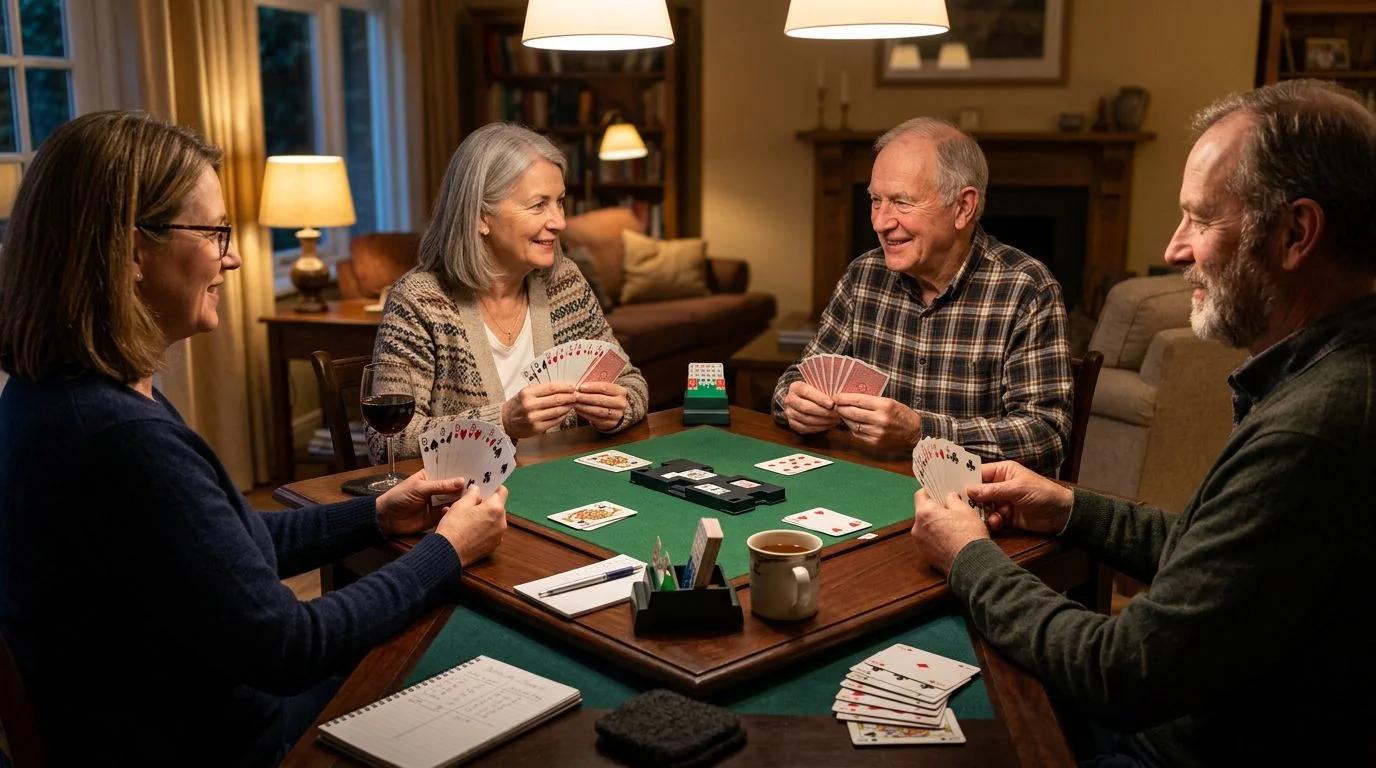
Bridge is a trick-taking card game played by four people in two partnerships. Partners sit across from each other. The game has two main phases: bidding (an auction to determine the contract) and play (trying to win enough tricks to fulfill the contract).
The goal is simple: during bidding, estimate how many tricks your partnership can win. During play, try to win at least that many tricks. If you succeed, you score points. If you fail, your opponents score.
Setup: What You Need
- Four players — You and three friends, arranged in partnerships (North-South vs. East-West)
- Standard deck of 52 cards — No jokers
- Score sheet — To track points (or use an app)
- Table — Square or round, with players seated around it
Partners sit opposite each other. If you're North, your partner is South. Your opponents are East and West.
The Deal
One player shuffles and deals the entire deck, one card at a time, clockwise around the table. Each player receives 13 cards. You pick up your hand and sort it by suit (traditionally: spades, hearts, diamonds, clubs from left to right).
Card Ranking
Within each suit, cards rank from highest to lowest:
A K Q J 10 9 8 7 6 5 4 3 2
The ace is the highest card. The 2 is the lowest. This ranking never changes.
Suits and Ranking
There are four suits, which have a ranking only during the bidding:
- Spades (♠) — Highest
- Hearts (♥) — Second
- Diamonds (♦) — Third
- Clubs (♣) — Lowest
- Notrump (NT) — Highest (no suit is trump)
During bidding, spades outrank hearts, hearts outrank diamonds, diamonds outrank clubs. Notrump outranks all suits. During play, the trump suit (if any) beats all other suits.
Phase 1: The Bidding (Auction)
After the deal, the bidding begins. This is an auction where partnerships communicate about their hand strength and decide on a contract — a commitment to win a certain number of tricks in a specific strain (suit or notrump).
How Bidding Works
Starting with the dealer and moving clockwise, each player makes a call. You have four options:
- Bid — State a level (1-7) and a strain (♣, ♦, ♥, ♠, or NT)
- Pass — Decline to bid (you can bid later)
- Double — Increase penalties if opponents fail their contract
- Redouble — Increase bonuses if you make a doubled contract
What Bids Mean
A bid has two parts: a level (1 through 7) and a strain (♣, ♦, ♥, ♠, or NT).
Example: 1♠ means "I propose that my partnership will win 7 tricks with spades as trump."
Why 7? Because the level represents tricks above 6 (called "book"). Level 1 = 6+1 = 7 tricks. Level 7 = 6+7 = 13 tricks (all of them).
Quick reference:
1-level = 7 tricks
2-level = 8 tricks
3-level = 9 tricks
4-level = 10 tricks
5-level = 11 tricks
6-level = 12 tricks
7-level = 13 tricks
Bidding Must Go Up
Each new bid must be higher than the last. You can bid higher by:
- Bidding a higher level (1♣ → 2♣)
- Bidding a higher strain at the same level (1♣ → 1♦)
Examples:
- After 1♣, you can bid 1♦, 1♥, 1♠, 1NT, or anything at the 2-level or higher
- After 1♠, you can't bid 1♣, 1♦, or 1♥ (those are lower). You'd need to bid 1NT or 2-level+
- After 3NT, you can bid 4♣, 4♦, 4♥, 4♠, or anything higher
When Does Bidding End?
The auction continues until three players pass in succession. The final bid becomes the contract.
Example auction:
South: 1♠
West: Pass
North: 2♠
East: Pass
South: 4♠
West: Pass
North: Pass
East: Pass
Three passes in a row, so bidding ends. The contract is 4♠ (North-South must win 10 tricks with spades as trump).
Phase 2: The Play
Once the bidding ends, play begins. The partnership that won the auction tries to make their contract. The other partnership tries to stop them.
Key Roles
- Declarer — The player in the winning partnership who first bid the strain of the final contract. They control both their hand and dummy's hand.
- Dummy — Declarer's partner. After the opening lead, dummy places their cards face-up on the table for all to see. Dummy doesn't make decisions during play.
- Defenders — The other partnership. They try to win enough tricks to defeat the contract.
The Opening Lead
The player to declarer's left makes the opening lead — they play the first card face-up on the table. Immediately after, dummy's hand is laid face-up on the table, organized by suit.
How Tricks Work
Play proceeds clockwise. Each player plays one card to the trick. You must follow suit — if you have any cards in the suit led, you must play one. If you have none of that suit, you can play any card.
The highest card in the suit led wins the trick unless a trump is played. If the contract has a trump suit, any trump beats any non-trump card. The highest trump wins.
Example (contract is 4♠, spades are trump):
- Lead: ♥K (king of hearts)
- Next: ♥3 (follows suit)
- Next: ♠2 (no hearts, plays a trump)
- Next: ♥A (follows suit with the ace)
Winner: The ♠2 wins because it's a trump. Even though the ♥A is the highest heart, spades are trump so the trump card wins.
If no trump is played, the ♥A would have won.
Continuing Play
The winner of each trick leads to the next trick. Play continues until all 13 tricks have been played.
Scoring: Did You Make It?
After all tricks are played, count how many tricks declarer won. If declarer won at least as many as the contract required, the contract is made and declarer's side scores points. If not, the contract is defeated and defenders score.
Basic Scoring
Scoring in bridge is detailed (and varies between rubber bridge and duplicate bridge), but the basics are:
- Making your contract — You score points based on level and strain
- Game contracts (3NT, 4♥, 4♠, 5♣, 5♦) — Big bonuses
- Slam contracts (6-level or 7-level) — Huge bonuses
- Overtricks — Small bonuses for tricks beyond your contract
- Defeating contracts — Defenders score based on how many tricks declarer fell short
Don't worry about memorizing scoring tables yet. Focus on understanding the flow of the game.
Strategy: Key Concepts for Beginners
1. High Card Points (HCP)
To evaluate your hand during bidding, count high card points:
- Ace = 4 points
- King = 3 points
- Queen = 2 points
- Jack = 1 point
A full deck has 40 HCP total. On average, you'll be dealt 10 points. With 12+ points, you have an opening hand. With 6-9 points, you can respond to partner's opening.
2. Distribution Matters
Long suits are powerful. A five-card suit gives you tricks after opponents run out of that suit. Voids and singletons are valuable in trump contracts (you can trump opponents' winners).
3. Trump vs. Notrump
Playing in a trump suit gives you control — you can stop opponents from running long suits by trumping. Notrump contracts score higher but require stoppers (high cards) in all suits to prevent opponents from running a long suit.
4. Communicate with Partner
Bridge is a partnership game. Your bids and plays convey information to partner. When you bid 1♠, you're telling partner you have 5+ spades and an opening hand. When you lead a king, you're often showing the queen too. Learning the language of bidding and play is what makes bridge fascinating.
Your First Game: What to Expect
Your first few games will feel overwhelming. That's normal. Here's what helps:
- Play with patient people — Find a beginner-friendly group or teacher
- Start simple — Learn basic bidding (Standard American 5-card majors) before fancy conventions
- Focus on following suit — This is the #1 rule violation for beginners
- Count your tricks — Before playing, count how many tricks you think you can win
- Don't worry about scoring — Let someone else track points while you focus on playing
Common Beginner Mistakes
- Not following suit — You must play the suit led if you have it
- Misunderstanding trump — Trumps beat all other suits, even aces
- Bidding without points — Don't bid just because you have a long suit; you need points too
- Forgetting the level — 1♠ means 7 tricks, not 1 trick
- Failing to count — Count your HCP, count your tricks, count opponents' tricks
Next Steps: Learning Beyond the Basics
Once you understand the flow of the game:
- Learn a bidding system — Standard American is most common for beginners
- Study basic conventions — Stayman, Jacoby Transfers, Blackwood
- Practice card play — Finesses, establishing suits, counting
- Join a club — In-person or online games with other learners
- Use an AI coach — Tools like Brian (our AI bridge coach) give instant feedback on your bidding
Bridge has a steep learning curve, but once you click with the basics, it becomes endlessly fascinating. The combination of bidding strategy, card play tactics, and partnership communication creates a game you can play for decades without exhausting its depth.
Ready to Practice?
Brian, our AI bridge coach, teaches you bidding step-by-step with real hands and instant explanations. Perfect for beginners.
Try Brian Free